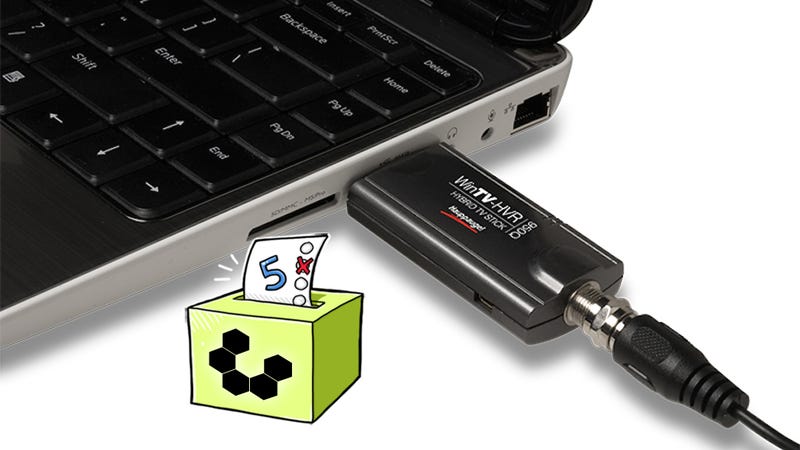
Usb Tv Tuner For Mac Mini
Yep, everyone's talking about using the, and there's a reason why: its diminutive form factor makes it a good candidate to fit unobtrusively into an existing audio/video or home theater setup. It looks more like a consumer electronics device than a computer, so it won't look out of place in your living room. We think of it as the central brain of our system; the glue that holds all the devices together. It can serve the role of scheduler, controller, audio/video recorder, audio/video playback, audio/video download, and it even makes a decent audio/video production unit, as well. You might not win the next Sundance with your iMovie, but you sure can impress everyone at the next family reunion. So for this week's How-To we'll cover the various aspects you'll need to think about when planning your Mac mini media center system, plus show you how to control your Mac mini headlessly from any computer in your house-there's no need to BYODKM; just BYOB, pop in a DVD and enjoy your HDTV, OK?
Watch Live TV On Your Mac - Mac TV Tuner CLICK HERE No hardware.
There's more than one way to skin a mini, so we're going to walk you through our setup and give some overview ofwhat tools are required. Audio and video connections are going to vary greatly depending on your particular setup, sowe'll do our best to show what we're doing with ours and give you a head start on what you'll need to get your ownsetup up and running. Most of the connections are fairly simple, so this how-to is geared towards covering the basicissues you'll have to resolve, plus show you how to divert the cash from the D, K, and M into better investments foryour media center. Without further ado.
Storage First problem to solve is the storage issue. Whether you get the 40GB or 80GB drive, you're still going to run out ofspace right quick. Start thinking about external storage right now. This is going to depend much on your availablespace, your personal preferences, and what equipment you already have lying around. If you have an old PC of any OSflavor lying around, now is the time to repurpose it into a file server.
You don't need a speed demon to serve in thiscapacity, because you can schedule large file transfers to happen overnight or at other times your home network isn'tin heavy usage. We turned an old PowerMac G4 400Mhz machine into our file server. It lives at the 'front end' of ourback end/front end media center solution, which we'll talk more about later. We run it headless, as well - another DKMchunk of change you can sink right back into extra storage. If you go this route, you'll want to soup up the chassis with as many hard drives as you can. Cannibalize old drives,look for sales online, keep an eye out for friends with neglected machines lying around. Leave no hard drive behind, myfriends.
Setting up your server on your home network should be fairly straightforward. You'll want the connection to be wiredfor faster file transfer. If the server machine is running OS X, getting it to talk with your Mac mini is easier thanselling a marked up iPod shuffle on eBay - your success is assured. If you're planning to set up your server as a Linuxbox, you probably don't need any further instruction from us. If your server is a Windows box and you'reunfamiliar with the vicissitudes of cross-platform networking, you'll have to do a little bit of research on bestpractices for smooth communications between the two. Visual studio for mac wikipedia. Sadly, this is beyond the scope of this how-to, but if many peoplerequest more information we may cover it in a future how-to. Express vpn mac download.
If you don't have a spare machine lying around to serve duty as a file server, you can either get a cheapo bare bonesPC to fill the role, or invest in an external storage solution. Depending on your needs, this can be as simple as asingle external Firewire drive; 250GB drives are going for less than $200. If you plan to ultimately burn most of yourrecorded TV and video to DVDs, you will most likely be fine with this solution. You can also daisy chain severalFirewire drives together (or use a Firewire hub), and add more as your needs require. An alternative to using external Firewire drives is to set up a Firewire enclosure, which converts one or more IDEdrives into a Firewire-accessible storage solution. This can be a more robust and compact solution to housing multipledrives, and it can also be less expensive than buying multiple Firewire externals.