Os-9 68k Emulator -mac -macos Dsk Image
Explains OS-9's disk file organization, raw physical I/O on RBF devices. OS-9/68000 Assembler/Linker/Debugger User's Manual. Design a part of a system's RAM to store video images and battery back up. Line 1010 emulator.
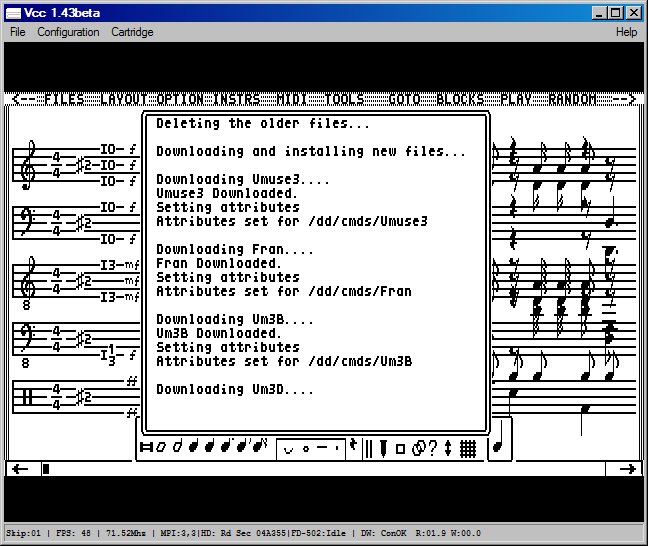
UltiMusE3 for Coco 3 & OS9 Lv 2 by Michael Knudson. UltiMusE3 is by far one of the best music software ever written for the Color Computer. With it's sixteen voice MIDI output and multiple music staff type entry via mouse on a Hi-Res graphics screen, you could say it was the CocoMax of music software. The MIDI implementation was very well thought out and easy to use.
Knudson, being a musician himself, created a unique environment for composing music using a variety of staff types including a percussion staff for drums. With programmable MIDI instrumentation, 16 tracks and a well written manual, you could push your MIDI instrument to it's limits.
Knudson used a unique way of storing the MIDI data in memory utilizing the Get/Put buffers for storage. This allowed fast response and screen updates as well as the best MIDI timing routines on the Color Computer.
Cdock 2 for mac os x sierra. Using OS9 level II allowed for the now familiar but then almost unheard of multi-tasking environment. I could load and play a 16 part song complete with drums and switch to another window and work on my song lyrics in a word processor while I listened to the music. Pull that off on a Commador 64!!!
I also used UltiMusE3 for live performance as my complete back band to accompany my electric/acoustic guitars and vocals. I used UltiMusE3 for about ten years or more and still use it today with my Coco emulators outputing to my PC's MIDI drivers via Vcc 1.4.3b w/Becker Port support and DriveWire4 MIDI. I still have a few of the.ume's around but most got transferred to my PC via a MIDI cable and are now in standard MIDI files (.mid) I hope to one day get them back to the Umuse format for the Coco. There was quite a few Umuse3 files uploaded to Delphi and now preserved on the net at RTSI and the Repository so there's plenty of music to listen to.
We can always use more. So let's hear 'em! PC LINUX X 'UltiMusE-LX (UmuseLX), up to 800x600 graphics, 3/2000, released 3/2001 The Bottom Line (Eat Dessert First) UltiMusE was born on 8-bit, 64K home computers with low-resolution graphics, at a time when the mouse and point-and-shoot menus were hardly known outside Xerox PARC and the MacIntosh user base. There were no GUI standards or widget libraries for menus, and Apple sued anyone who tried to market a GUI-based OS (like GEM). Thus UltiMusE's first LINUX release doesn't have the look and feel of now-standard GUIs, even such antiques as Ghostview and Bitmap. Future releases will go to V classes or Athena 3D widget sets if popular acceptance makes this worthwhile. But since UltiMusE was written in C for the UNIX-like system, it was easy to port to LINUX except for the X Window interface.