
No Code For Changing Background Color Excel Vba Mac
Download Free Mkv Player To 10.6.8 - real advice. VLC media player. Categories Mac. Log in / Sign up. Advice › Free mkv player to 10.6.8. Free mkv player to 10.6.8 social advice Mac users interested in Free mkv player to 10.6.8 generally download. Mac OS X 10.3. Or later.WMV, or MKV to these.for Quicktime Player. 
I have a formula for Automatic Tab color change that works when I manually change the cell, but it does not work when the cell is changed by a function updating it from another sheet: =SUM('MEDENT Proposal - Creator'!B15) Question 1. Can I just change my VBA to look directly at the cell in the other sheet 'MEDENT Proposal - Creator'!B15?
Is there another way to write this VBA so that it will automatically update the Tab Colors - is the following written incorrectly? Again, it works if I manually change Cell 'A1' in that sheet. Private Sub Worksheet_Change(ByVal Target As Range) MyVal = Range('A1').Text With ActiveSheet.Tab Select Case MyVal Case '0'.Color = vbRed Case '1'.Color = vbGreen Case '2'.Color = vbGreen Case '3'.Color = vbGreen Case '4'.Color = vbGreen Case '5'.Color = vbGreen Case '6'.Color = vbGreen Case '7'.Color = vbGreen Case '8'.Color = vbGreen Case '9'.Color = vbGreen Case Else.ColorIndex = xlColorIndexNone End Select End With End Sub. • You can make it work even when it's a formula referencing another worksheet by using the Worksheet_Calculate event instead. • The Worksheet_Calculate won't fire when you manually change the cell so you'll need both if you want both scenarios to work. • You'll need to drop the code into each worksheet module you want to be affected. • You should use Me.Tab instead of ActiveSheet.Tab unless you want it to color whatever tab you happen to be on which you probably don't.
• You can really shorten your Select Case statement if you convert the value to an actual integer. Private Sub Worksheet_Calculate() ColorMyTab End Sub Private Sub Worksheet_Change(ByVal Target As Range) ColorMyTab End Sub Private Function ColorMyTab() Dim myVal As Integer myVal = 99 On Error Resume Next myVal = CInt(Range('A1').Value) On Error GoTo 0 With Me.Tab Select Case myVal Case 0.Color = vbRed Case 1 To 9.Color = vbGreen Case Else.ColorIndex = xlColorIndexNone End Select End With End Function If you want the code to simply watch the cell value on the MEDENT sheet, you can write a very similar script in the code for that worksheet module. Since it's watching just that sheet, though, you'd have to hard-code which tabs you want it to color. Does the MEDENT sheet control the color for several tabs? Are those tab names stored in column A:A the values you're changing are in column B:B? If you give us more information about what your ultimate goal is, we can recommend better solutions.
Issue I've a spreadsheet when I need to change the row color dependent on the data entered into a particular cell. The current VBA code, below, only changes the individual cell and not the row. Change Background Color of Cell Range in Excel VBA – Download: Example File Here is the sample screen-shot of the example file. Download the file and explore how to change the interior or background colors in Excel using VBA.
When the user enters a new value in cell B2, the old value is gone so the old value has to be stored somewhere. Outlook for mac set 24 hour clock free. The easiest way to do this is to save the value in some remote part of the worksheet. I picked Cells(999,999). Doing it this way can get you in trouble because the user can clear or overwrite the cell. Also, having a value in this cell will create problems for some operations such as finding the 'last' cell.
This cell will usually be the 'last' cell. If any of these things are a problem for your code, you might want to keep the value in a small file that is created when the spreadsheet is loaded. The code here changes the background color of a cell can be by changing the color value of Selection.Interior.ThemeColor. This is new in Excel 2007.
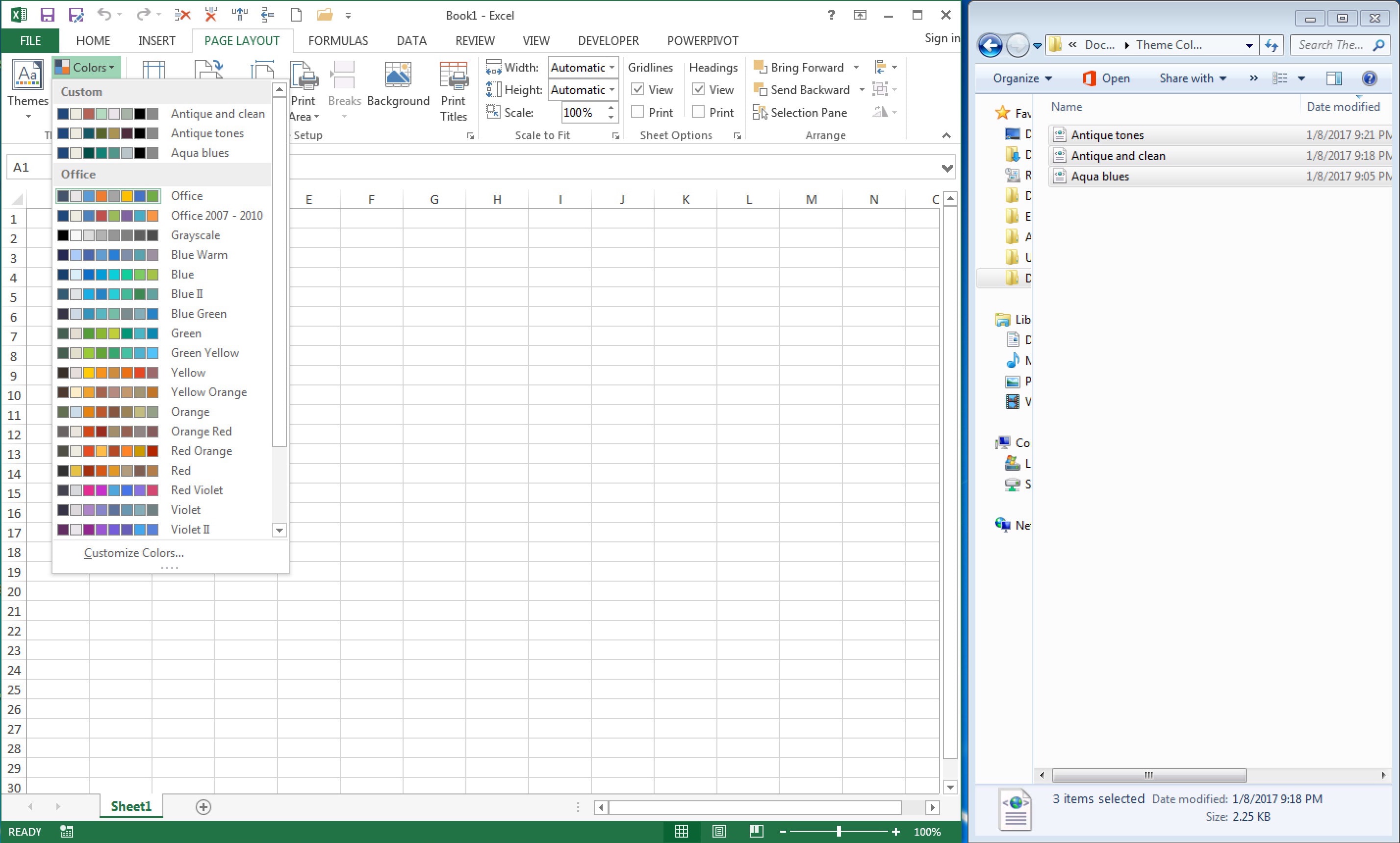
Microsoft added this feature to all Office 2007 programs so they could provide compatibility across them with the idea of 'Themes'. Microsoft has an excellent page explaining Office Themes at their site.
Since I was unfamiliar with Office Themes, but I knew they would produce a nice shaded background, my initial try at changing the background color was to code. Selection.Interior.Color = vbRed To pick three shaded colors that actually work, I used the 'Record Macro' feature and selected colors from the palette to get the 'magic numbers' I needed. That gave me code like this: With Selection.Interior.Pattern = xlSolid.PatternColorIndex = xlAutomatic.ThemeColor = xlThemeColorAccent1.TintAndShade = 0.88629.PatternTintAndShade = 0 End With I always say, 'When in doubt, let the system do the work.' Avoiding an infinite loop This is by far the most interesting problem to solve.