Install Disks For Mac Os X
Most of the time you'll never have to worry about having to install a new operating system on your Mac - the one that's on there should work fine through thick and thin. But every once in a while you might want or need to - here are step by step instructions for making it happen. Use Recovery Mode Every Mac operating system since Lion (OS X 10.7) has included Recovery Mode, a special boot partition that enables you to recover from catastrophic failures and problems.
This can be used to install a fresh copy of Mavericks on your hard drive, provided you have Internet access. To use Recovery Mode, follow these instructions: • Shut down your Mac. • Press the Power button (the button marked with a O with a 1 through it) • Immediately press the command (cloverleaf) key and R together. • Make sure you're connected to the internet through Wi-Fi. If you're not, choose a network from the Wi-Fi menu that appears at the top-right corner of the screen.
Simplify creating a bootable macOS installer. What's needed for a clean install on a Mac. Install wget for mac. Download the OSX App.
• Select Install Mac OS X, then click Continue. It's worth noting that this installs a fresh copy of OS X on your Mac without affecting either your files or your user settings, so you should be good to go as soon as it reboots. All applications are maintained, as well. Ps1 mac emulator change discs. This system simply replaces the core files that enable OS X to operate. I've had occasion to see systems that don't work with Recovery Mode, for some reason. For those computers, it's often possible to restore access to the Recovery Mode partition by resetting the System Management Controller (SMC).
To reset the SMC on most Macs: • Shut down the Mac. If it's a laptop, make sure it's connected to the power cord. • Hold down the Control, Option, and Left Shift keys simultaneously, then press the Power button.
• Release the keys. • Press the Power button again. The system should turn on and you can give Recovery Mode another try.
If that fails to work, you can always download a fresh copy of the Mavericks installer from the Mac App Store. Download a fresh copy of Mavericks from the Mac App Store • Open the Mac App Store application, either from your Dock or from the Applications folder. • Click on the Purchases tab at the top of the window or press command and 4 on your keyboard. (I'll assume for the moment that you have already installed Mavericks once - if you haven't, you should see an installation option in your Updates folder, assuming you have Snow Leopard or later installed.) • Find OS X Mavericks in the list of files, either scrolling through the list or using the Search field in the upper right hand corner of the window.
• Click the Download button. • You may get a dialog box advising you that OS X 10.9 is already installed on this computer. It's safe to click the Continue button. • Be prepared to wait a while. Even over a fast Internet connection, it'll take a little while to download, since it's more than 5 GB.
• Once it's downloaded, it'll launch automatically. Follow the directions to install OS X.
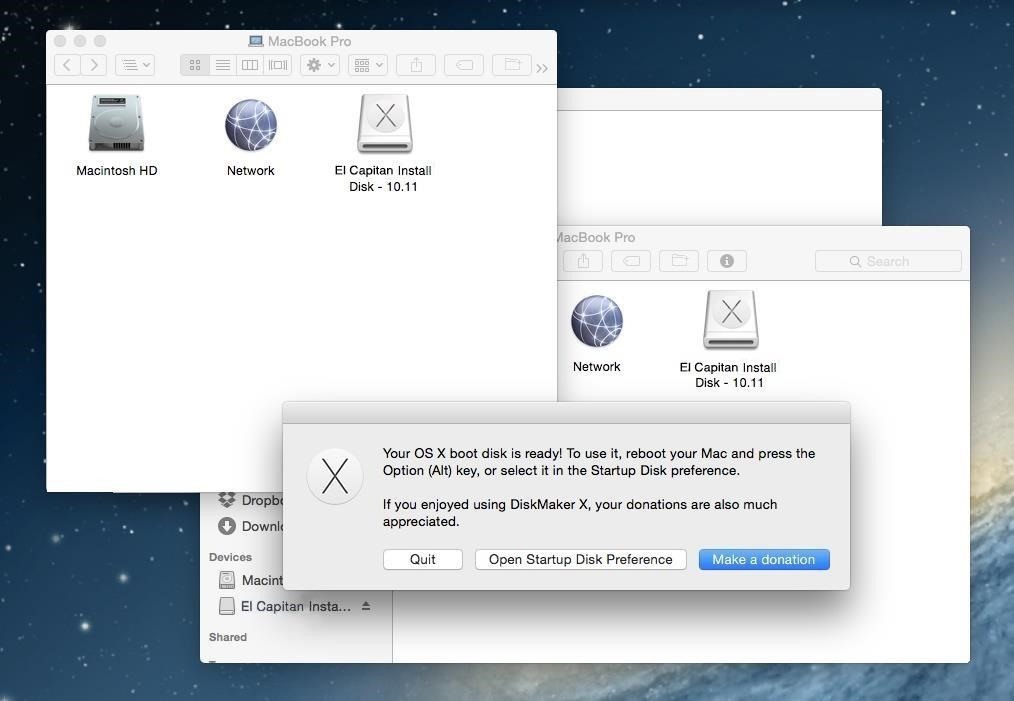
By • 9:20 am, July 25, 2012 • • • Apple only sells OS X Mountain Lion as a digital download in the Mac App Store. The installer weighs in at a hefty 4.05GB, but the good news is that you can install your copy of Mountain Lion on all of your Macs for no extra charge. Technically, the Mountain Lion installer can be used on an infinite number of Macs once you have it; you just need to make a bootable disk or drive.
See, the Mountain Lion installer is set to self-destruct once it’s used. When your Mac reboots running Mountain Lion, the installer will be gone and you’ll have to re-download it if you want to use it again. Another reason to create a bootable copy of Mountain Lion is if you want to do a clean install. Apple’s installer will keep your files and personal setup intact while installing Mountain Lion, but a bootable disk will allow you to erase your Mac and start completely anew. The good news is that creating a bootable disk or USB drive of Mountain Lion is pretty simple. Before you begin: You’ll need to make a backup of your Mountain Lion installer before trying to create a bootable copy. Use the copy you make to create a bootable disk or follow this process before you install Mountain Lion on the Mac you’re currently using.